
Are your stakeholders using different words when describing data to mean the same thing?

By | 06/05/2016

A entity relationship or class diagram can be used to resolve the problem when stakeholders are interchangeably using different words to mean the same thing.

For the purposes of this article a conceptual model of a class diagram has been used.  A conceptual model is at class level.  A class is a group of data with similar characteristics.  The different characteristics are known as attributes.

Writing down each type of data mentioned and drawing out the relationships between them will help understand the data and agree common definitions.

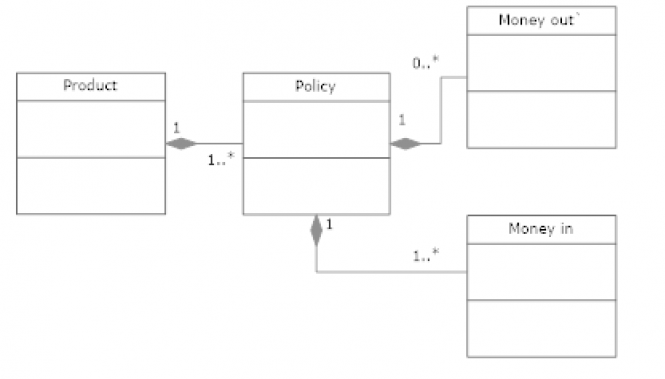
Taking the example in the diagram identifies 4 classes.

These are:

  • Product
  • Policy
  • Money out
  • Money in

Other terms for money out could have been movements, claims, transactions, payments and so on.  Writing out all of the words used and then agreeing which term to use will help prevent duplication and misunderstandings.  This is particularly useful for specialised areas where a lot of jargon may be used.

Drawing out the relationships between the classes will provide an understanding of whether the data is at class or attribute level.  If the relationships drawn out are one to one then they may be part of one class so will be attributes, if there is a one to many relationship then they are separate classes.

In the diagram the following can be ascertained by the relationships shown:

  • a product can belong to one to many policies however a policy can only contain one product
  • a policy may have zero to many instances of money going out however a money out instance will only relate to one policy
  • a policy may have one to many instances of money going in however an instance of money in will only relate to one policy

This type of diagram can be put together fairly quickly in a workshop and provide a lot of information about the data required.

Thoughts? Questions? Please share in the comments.

Author: Helen Winter

Helen Winter is an enterprise transformation leader, author, and operating model strategist with deep experience in designing and delivering complex organisational change. She has led transformation programmes across multiple organisations and sectors, focusing on the operating model mechanisms that link strategy to execution — including commercial model redesign, governance frameworks, squad operating models, PMO modernisation, financial controls, tooling and data alignment, and AI-enabled delivery. Her work centres on helping organisations build operating models that deliver predictable, efficient, and value-driven outcomes. Her expertise spans transformation programme design, enterprise agility, cross-functional governance, behavioural and cultural change, and the practical integration of tools and processes to improve business performance. Helen is also a global business author with Kogan Page. Her first book, The Business Analysis Handbook, was a finalist for two major industry awards: the PMI award for contribution to project management literature and the Business Book Awards’ Specialist Book category. She is an active member of the APM Programme Management Specific Interest Group, contributing to thought leadership, guidance, and the development of good practice for programme delivery. A frequent speaker at project, programme, and transformation forums, Helen shares her insights through her long-running blog BusinessBullet.co.uk, visited by over 5,000 readers a month. Her current writing focuses on modern operating models, transformation leadership, organisational capability, and the real-world dynamics that determine whether change succeeds or fails.

Leave a Reply

Your email address will not be published. Required fields are marked *

This site uses Akismet to reduce spam. Learn how your comment data is processed.