


Delivery without a system
Delivery problems rarely stem from a single failure. They tend to emerge from how work enters the organisation, how priorities are set, and how people and teams are arranged to deliver it. When these elements are loosely connected, delivery is left to cope rather than operate with any real stability.
This is an example of the delivery dysfunction described in the previous article on operating model gaps.
Work arrives through multiple routes. Requests come via projects, support queues, emails, conversations, and escalations. Some are planned, others are urgent, and many are important. Priorities are set in different places, at different times, using different criteria. What is agreed in one forum is often overtaken by decisions made elsewhere, sometimes without anyone explicitly noticing.
Teams exist, but people are frequently pulled into other work. Specialists are shared across initiatives, capacity is assumed rather than protected, and interruptions are treated as exceptions even when they occur daily. Defects, rework, and post-release support are handled as they arise. Some of this is planned, much of it is not, and most of it is absorbed quietly.
None of this is unusual. It is simply how delivery is set up.
What this structure creates
In this kind of setup, it becomes difficult to see how much work is actually in progress, where delays are occurring, or what capacity truly exists. Plans rely on assumptions that change week to week as priorities shift, people are redirected, and new work arrives through side doors.
Delivery becomes hard to predict. Timelines move, commitments slip, and estimates and actuals drift apart, not because teams lack skill, but because the conditions those plans were based on no longer hold. Without a stable baseline, learning is limited. Each planning cycle starts again, with little opportunity to understand what is genuinely driving delay, rework, or quality issues.
Over time, unresolved trade-offs show up in people rather than in decisions. This is when delivery teams are described as overloaded.
Why overload isn’t the problem
Overload is not a planning failure or a lack of effort. It is the visible effect of work entering through too many routes, priorities competing silently, and capacity being overridden as a matter of course.
Instead of the organisation making deliberate choices about what should stop when something new starts, those choices are made informally, day by day, by the people doing the work. Seen this way, overload is not the cause of delivery dysfunction. It is the signal that demand is unmanaged and decisions are being deferred.
Teams without stability
One of the clearest signs of delivery dysfunction is when teams exist in name but not in practice.
On paper, teams appear stable. In reality, people are regularly pulled into other work to support issues elsewhere, respond to urgent requests, or cover gaps created by earlier commitments. What looks like a team structure is, in practice, a loose network of shared individuals.
Specialist roles are spread across too many initiatives, creating bottlenecks that plans rarely account for. Availability is assumed rather than protected, and capacity is treated as flexible even when delivery plans depend on it being stable.
Without stable teams, there is nothing reliable to plan against. Estimates become provisional, and commitments are built on assumptions that rarely hold for long. Capacity exists only on paper.
This is not a failure of commitment or effort. It is a structural outcome of how work and people are organised.
Fragmented work, fragmented visibility
These issues are compounded when work is spread across multiple tools and entry points. Some work is tracked, some is not. Some is prioritised centrally, some locally. As a result, there is no single view of demand or work in progress.
Teams may be busy, but leadership cannot easily see what they are busy with or why. Without visibility of flow, trade-offs remain implicit. Reporting focuses on activity rather than progress, and predictability steadily erodes.
When estimates and actuals never align
In environments like this, estimates and actuals rarely match. Not necessarily because teams are poor at estimating, but because the assumptions behind those estimates are continually undermined. Work is interrupted, scope shifts informally, capacity changes week to week, and defects and rework are absorbed without being reflected in plans.
Without a reliable data foundation, learning stalls. Future plans repeat the same patterns, built on hope rather than evidence.
Designing delivery deliberately
When delivery works well, certain structural conditions are in place. Teams are kept intact long enough for capacity to mean something. Work enters through clear routes so demand can be seen before commitments are made. Priorities are explicit, and interruptions are handled deliberately rather than absorbed by default.
This is what it looks like when delivery is treated as something to be designed, rather than something that simply happens.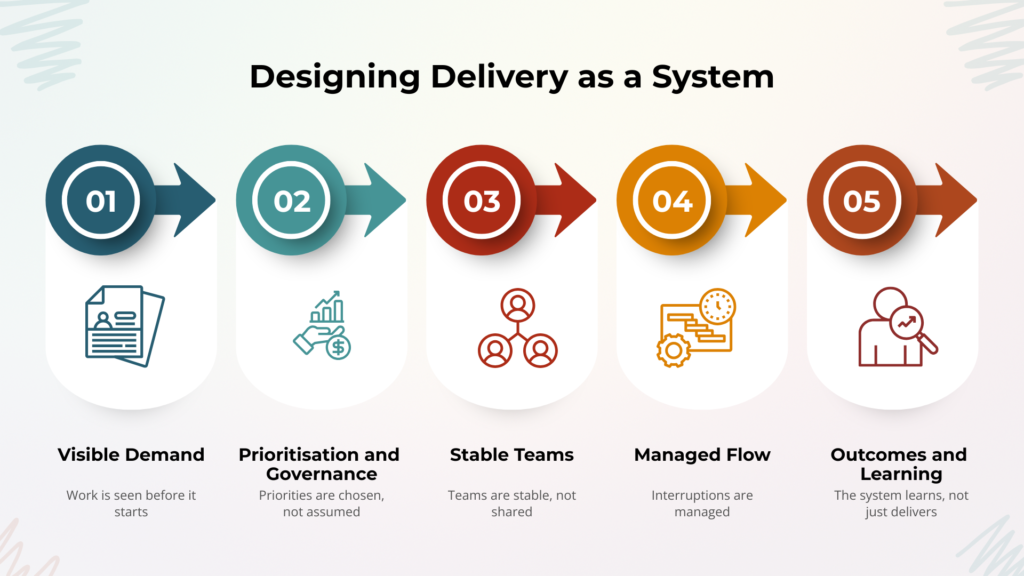
Planning capacity without guesswork
Capacity planning often starts with a question about people: how many are available, and where are they needed? In practice, that question can’t be answered reliably until demand is visible, teams are stable, and interruptions are recognised as demand rather than treated as exceptions.
When those conditions are missing, capacity planning becomes speculative. Plans rely on optimistic assumptions about availability and priority stability, and resource allocation turns into negotiation rather than decision-making. When those conditions are in place, planning becomes simpler, not because capacity is perfectly measured, but because the system has enough shape to reason about trade-offs.
Leaders can see what is already in progress, what would need to stop for something new to start, and where pressure is building. At that point, resource allocation becomes a governance activity rather than a personal one.
Closing thought
Delivery dysfunction does not come from a lack of effort or capability. It arises when demand, priority, and capacity are left unresolved by the operating model.
Designing delivery deliberately does not remove hard choices, but it does make those choices visible, explicit, and shared which is what allows delivery to support strategy rather than struggle beneath it.


