


Accountability is one of those topics that comes up again and again in organisations. People say it’s missing. Leaders say they want more of it and teams feel the impact when it isn’t clear. Despite all the conversations it may not improve in any meaningful or lasting way. This typically happens when accountability is being treated as a people or behaviour problem. In reality it is far more often an operating model problem.
When accountability feels weak the instinctive response is to look at individuals. People are encouraged to “step up”, “take ownership”, or “be more accountable”. Sometimes roles are rewritten, responsibilities clarified, or new RACI charts produced.
These actions are usually well intentioned. But they often miss the point.
You can’t expect people to take accountability in a system that makes it unclear what they are actually accountable for, what authority they have to act, or where decisions really sit. Asking for more accountability simply adds pressure without changing the underlying reality.
Accountability Dependencies
In practice accountability only works when the environment supports it.
People can only be accountable when they:
- know which decisions they own
- have the authority to make those decisions
- understand the trade-offs they are expected to manage
- have access to the information needed to act
- know when and how to escalate
Without these conditions accountability becomes theoretical. People may be responsible for tasks but they are not genuinely accountable for outcomes. This is why accountability is shaped far more by operating model design than by personal intent.
Operating Model Ambiguity
In many organisations accountability breaks down because the operating model is ambiguous because decisions appear to sit in multiple places. Here are some examples:
- Delivery teams are accountable for outcomes but not for priorities or resourcing.
- Programme managers are accountable for timelines but not for scope changes.
- Senior leaders retain decision rights informally, even when those decisions are meant to be delegated.
As a result, people hesitate. Decisions are deferred “just in case” and escalations becomes political rather than practical. People may care but the ownership is blurred because the system doesn’t make ownership explicit. Over time, this creates frustration and slows delivery. Strategy execution starts to feel harder than it should be.
Accountability Issues in Transformation
Periods of transformation often make accountability worse unless it is deliberately redesigned. New roles often get introduced and temporary governance structures are layered on top of existing ones. Teams also then operate across both business-as-usual and change activity. This then causes reporting lines blur and multiple decision forums.
In these conditions, accountability gaps open quickly. People aren’t sure which rules apply, who has the final say, or where decisions should be made. To protect progress, decisions get pushed upward. To protect themselves, people avoid owning trade-offs.
None of this is a failure of commitment. It’s a predictable outcome of unclear design during change.
Defining Accountability
One of the most common mistakes organisations make is assuming accountability sits neatly in the organisation chart along with role descriptions and governance documents. In practice it rarely does. Instead, accountability shows up in how decisions actually flow through the organisation. For example:
- Who can approve changes.
- Who sets priorities.
- Who is able to trade time cost and scope.
- Who ultimately absorbs risk when things do not go to plan.
Accountability Best Practices
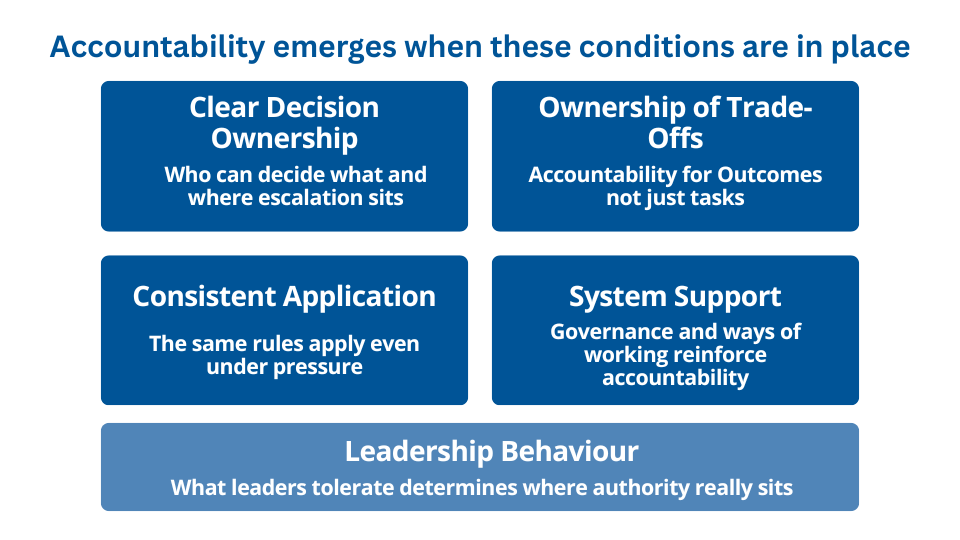
The accountability by design framework sets out four conditions that are typically present when accountability works well in practice. These are not new ideas in themselves. Most organisations will recognise them from existing governance and delivery approaches. What matters is whether they are deliberately designed to work together.
The first condition is clear decision ownership. This relates to familiar approaches such as the RACI model, which is intended to help determine who is responsible for making decisions and who needs to be involved or informed. Used properly, it makes ownership explicit and ensures escalation points are identified upfront rather than being worked out under pressure.
The second condition is ownership of trade-offs. This comes from established programme and portfolio management practice, where accountability sits with outcomes and benefits rather than individual activities. It means being responsible for the decisions that protect value when priorities shift or assumptions change.
The third condition is consistent application. This is a core principle in effective governance, where decision rights and rules are meant to hold even when pressure increases. Accountability only works when the same expectations apply regardless of seniority, urgency or who is asking.
The final condition is system support. This comes from operating model and governance design, where structures, forums and ways of working are expected to reinforce accountability rather than rely on individual effort to compensate.
Underlying these conditions the role of leadership need to support the model by exhibiting behaviour that supports these conditions and not tolerate any changes that contradict it.
Conclusion
Accountability rarely becomes unclear because of a lack of intent or effort. More often, it reflects how decisions are structured, how ownership is defined, and how consistently those expectations are reinforced. When the conditions around decision-making are stable, ownership tends to follow naturally. When they are not, accountability becomes difficult to hold, regardless of commitment.
Seen this way, accountability is less about individual behaviour and more about design. It depends on whether the operating model makes ownership visible, supported, and sustainable. When those conditions are deliberately put in place, accountability becomes part of how the organisation works. When they are left implicit, it remains fragile and uneven, surfacing only when things go wrong.


