


Introduction
Most strategies don’t fail because they’re poorly designed. They fail because the organisation simply isn’t built to deliver them. This disconnect between what leadership intends and what the organisation is capable of executing is what I call the operating model gap.
In every transformation programme I’ve led, the same pattern has emerged. Strategies rarely break in the boardroom. They break in the day-to-day systems, processes, behaviours, and decision-making structures that make up the operating model. When these mechanisms don’t work, the strategy no matter how compelling doesn’t stand a chance.
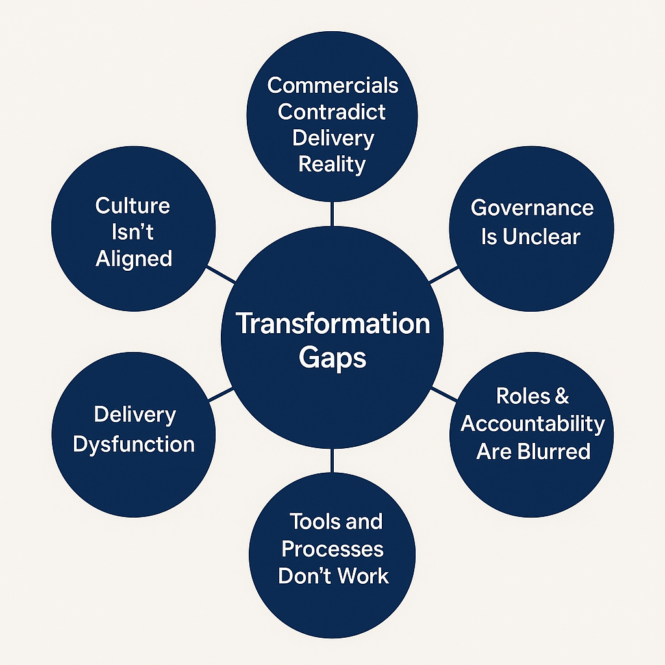
Across multiple organisations and industries, I’ve consistently seen six operating model gaps that derail strategy execution. Understanding these gaps is the first step to closing them.
Gap 1: Commercials Contradict Delivery Reality
Commercial and delivery models must work hand in hand. Problems arise when pricing and commitments are agreed without validating the assumptions underpinning them. Sales may commit to scope, timelines, or effort based on incomplete information, leaving delivery teams to absorb the consequences later.
This is why effective communication between sales and delivery is essential. Delivery should be involved early in tenders to clarify assumptions, highlight dependencies, and validate the risks or unknowns that could materially impact the cost to deliver.
Committing to a fixed price without documented assumptions, confidence levels, risks, scope boundaries, and dependencies is a gamble. When these aren’t written down, it becomes almost impossible to justify changes later. I’ve also seen organisations blur the lines between fixed price and time-and-materials, delivering one as if it were the other; an approach that leads quickly to revenue leakage.
Gap 2: Governance is unclear
Weak governance creates disorder. Without a clear “front door” for new work, organisations lose visibility of what is entering the system, who owns it, and how it should be prioritised. Work arrives unexpectedly from multiple channels, and teams become reactive rather than strategic.
Governance breakdowns often occur when senior leaders bypass PMO or commercial gates in the hope of speeding things up. While this may feel faster in the moment, it frequently creates more rework later: missing requirements lead to redesign; missing testing leads to extended defect cycles; missing planning leads to misaligned expectations.
In many organisations, governance is reactive. Teams firefight instead of preventing issues upfront, and heroics get rewarded more than disciplined delivery. Without controls for scope creep or clear processes for approving write-offs, hidden work expands quietly and eats away at profitability. Good governance doesn’t slow delivery down. It creates the conditions for it to run predictably and without chaos.
Gap 3: Delivery Dysfunction
Delivery dysfunction tends to reveal itself in familiar ways: teams claim they are overloaded but can’t show capacity; dashboards showing throughput or blockers don’t exist; delivery becomes unpredictable; meeting strategic timelines feels impossible.
Underneath these symptoms are structural issues. Squads exist in name only, with people constantly pulled away to work elsewhere. Work is scattered across different tools, making it hard to see what is in progress or planned. Estimates and actuals fail to align because there is no reliable data foundation. These issues then cascade into poor defect management, extended hypercare, and frustration across the organisation.
When delivery mechanisms are fragmented, even the best strategy struggles to gain traction.
Gap 4: Cultural Resistance & Accountability Gaps
Culture is one of the most powerful elements of an operating model and one of the easiest to overlook. When leaders protect the old way of working, the organisation stays anchored to the past even as the strategy pulls it in a new direction.
I often see decisions made on opinion rather than data, or a hero culture in which late-night rescues are celebrated instead of addressing the systemic issues that made them necessary. In some cases, teams intentionally underestimate or downplay effort to please stakeholders or avoid difficult conversations.
Culture determines whether people adopt new processes or subvert them. Without clear expectations and aligned behaviours, the operating model cannot take root.
Gap 5: Tools and Processes don’t work
As organisations grow, the tools and processes that once worked begin to crack under the weight of increased demand. Systems that were never integrated become bottlenecks. Processes that were never formalised become sources of inconsistency. Teams revert to workarounds because the official method feels too slow or too confusing.
When the organisation relies on disconnected tools and inconsistent processes, information becomes fragmented and visibility disappears. Without a single, trusted view of the truth, the operating model cannot support the strategy. Processes are the foundation of the operating model: they define how work flows, which tools are needed, and what roles and skills are required.
Gap 6: Roles and accountabilities are blurred
When roles lack clarity, friction is inevitable. Decisions slow down because no one is sure who owns them. Responsibilities overlap or fall through the cracks. Teams duplicate effort because boundaries aren’t defined.
Clear accountabilities create alignment and speed. Without them, even small decisions become difficult, and strategy execution becomes sluggish and frustrating.
Conclusion – Strategy Doesn’t Fail in the Boardroom. It Fails in the Operating Model.
Most organisations don’t have a strategy problem. They have an operating model problem. If the organisation isn’t designed to deliver the strategy, then success depends on luck, heroics, or working unsustainably hard.
The operating model is the bridge between strategy and results. When that bridge is weak through unclear governance, commercial misalignment, poor delivery structures, ineffective tools, misaligned culture, or blurred accountabilities the strategy collapses under its own weight.
Closing these gaps is the foundation of successful transformation.


