


Most delivery challenges don’t start in delivery. They start much earlier in the commercial discussions and assumptions that shape the work long before a team begins mobilising. I’ve seen this repeatedly across different organisations and transformation programmes. The strategy makes sense. The teams are capable. Yet the delivery still struggles. Not because of poor execution but because the commercial model beneath it was never aligned with what the organisation could realistically deliver.
This is one of the most common gaps I see, and also one of the least discussed. On the surface, it can look like a resourcing issue, an estimation issue or a planning issue. But underneath the root cause often points back to certain commercial decisions made before delivery were made with incomplete information, unvalidated assumptions or an optimism that didn’t reflect the reality on the ground.
Commercial misalignment isn’t simply a sales problem. It’s a structural operating model problem. And when it isn’t addressed early, delivery teams inherit constraints that were never achievable from the start.
In my previous article, Why Strategy Fails — The Operating Model Gap No One Talks About, I outlined six recurring gaps that sit between strategy and execution. One of the most common is where commercial commitments contradict delivery reality. This article focuses on that gap in more detail and introduces a practical framework for addressing it.
Why Commercial Alignment Is Part of the Operating Model
Commercials often sit outside of day-to-day delivery conversations, but they shape almost everything that follows. They influence how much time and budget is available, what has been promised, how flexible the scope is, who carries the risk, which roles are needed and what level of change-related effort has already been assumed.
Before a team even begins planning, these decisions have already set the boundaries for what’s possible.
When commercial and delivery realities don’t match, the operating model becomes stressed. The organisation might unintentionally commit to work it doesn’t have the capacity for, or timelines that were based on assumptions rather than detailed understanding. Delivery teams then spend their time fixing, negotiating and resetting expectations rather than delivering value.
This is why commercial alignment isn’t a paperwork exercise. It’s a core part of whether a strategy can be executed at all.
Where Misalignment Shows Up: Five Common Patterns
Across organisations, the same patterns tend to appear. These are subtle at the start but grow into much larger challenges over time.
- Assumptions that are never validated
Commercial agreements often rely on assumptions that aren’t documented or reviewed. Scope boundaries might be unclear, data quality untested, dependencies unknown or timelines guessed long before delivery teams are involved. When assumptions aren’t surfaced and agreed the organisation carries invisible risks into delivery.
- Capacity that simply doesn’t exist
A commitment to start work “next month” often happens before anyone checks the actual availability of specialists or teams. Teams may already be at capacity, or critical roles stretched across too many priorities. When the commercial model assumes a capacity that isn’t there, delivery falls behind immediately.
- Mixing fixed price and T&M mindsets
Fixed price requires clarity and firm boundaries whilst Time and materials requires transparency and flexibility. When the two mindsets are blended unintentionally, scope creep becomes informal, the wrong party absorbs the risk, and both sides feel the work is harder than it should be.
- Optimism in estimation
Sometimes estimates are reduced to meet a budget. Sometimes they’re provided too early, before enough is known. Either way, delivery starts with pressure built into the timeline, and the room needed to handle complexity or unexpected work simply isn’t there.
- Weak or absent commercial governance
Commercial risks, scope clarifications and write-offs often receive limited senior visibility. Without the right governance, issues surface too late, commitments go unchallenged and change control becomes informal. Delivery teams then absorb the impact quietly, often at the expense of quality or staff wellbeing.
The Hidden Costs That Extend Beyond Delivery
Misaligned commercials don’t only affect delivery teams. The impact is felt across the organisation.
Revenue leakage
Unplanned effort, undocumented scope creep and unbillable work all begin to accumulate. Even small variances multiply over time.
Reputational damage
Deadlines slip, quality drops and relationships become strained. Stakeholders lose confidence, and teams feel they are constantly defending the plan rather than delivering it.
Team burnout
People feel they are doing their best within constraints that were never realistic. This creates pressure, frustration and reduced morale, even in strong teams.
Operating model instability
Unmanaged commercial commitments disrupt capacity planning, prioritisation, team stability and reporting. The organisation becomes reactive rather than predictable.
What Good Looks Like: Building Commercial Alignment into the Operating Model
To close the gap where commercial commitments contradict delivery reality, organisations need a small number of consistent behaviours embedded into the operating model.
Commercial alignment doesn’t need to be heavy or bureaucratic. It simply requires shared understanding early on, supported by clear practices that help the organisation move from assumption to evidence before committing to work.
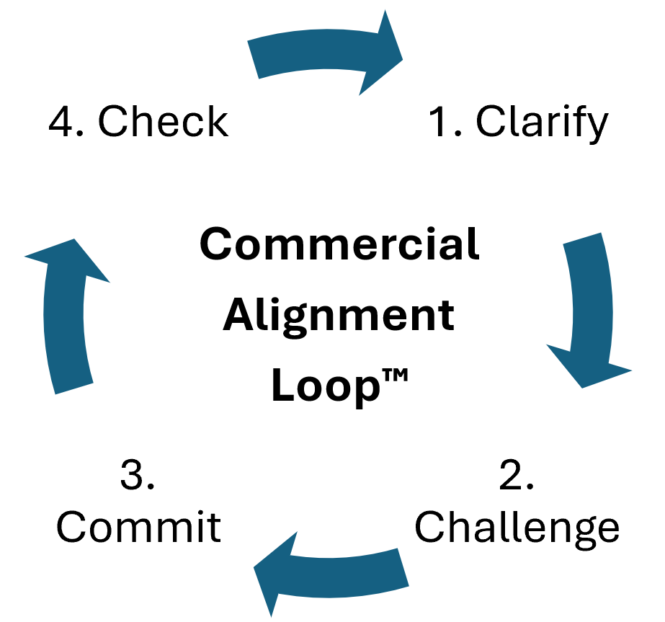
Through my work on transformation programmes, I’ve observed the same failure patterns repeat themselves across different organisations. To address these, I’ve developed the Commercial Alignment Loop™. This is a simple but effective framework that helps organisations align commercial decisions with real delivery capability. It focuses on four disciplined behaviours:
Clarify
Surface assumptions, scope boundaries, data constraints, risks and dependencies before anything is agreed.
Challenge
Bring sales, delivery and finance together to validate feasibility, confidence levels, timelines and capacity.
Commit
Make commercial agreements based on validated information rather than early estimates or untested optimism.
Check
Revisit assumptions once delivery begins, ensuring commercials remain aligned as new information emerges.
When these four behaviours become part of the operating model, commercial misalignment reduces significantly and delivery becomes far more predictable and less stressful.
Conclusion
Commercial misalignment usually happens because different parts of the organisation are working with different information at different times. The impact is significant and it shapes delivery long before the work begins.
When the commercial model reflects delivery reality the organisation finally gives itself the conditions it needs to deliver consistently, confidently and without unnecessary stress.
It is one of the most achievable improvements an organisation can make and one that immediately strengthens its operating model.
Addressing this gap alone can remove a significant amount of friction from delivery and create the conditions needed for the other operating model gaps to be tackled more effectively.


