


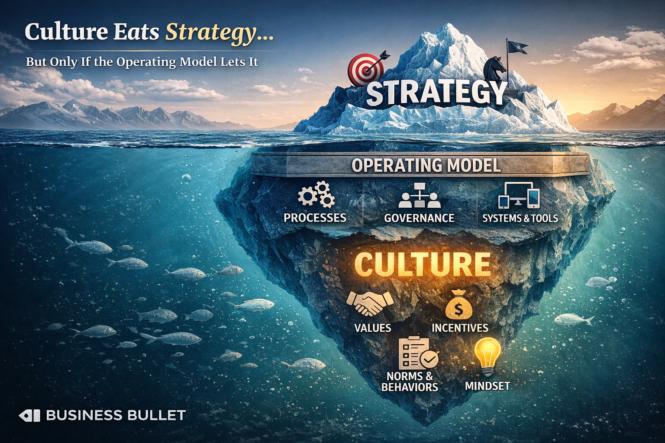
“Culture eats strategy for breakfast” is one of the most quoted phrases in business. It’s usually offered as an explanation when a strategy that looked sound on paper fails to land in practice. And there is truth in it. Culture does matter. It shapes how people behave, how decisions are made, and how work really gets done.
However, I’ve found that when organisations stop at culture as the explanation, they often stop short of the real issue.
In many transformation programmes I’ve worked on, culture isn’t the starting problem. It’s the outcome of something deeper. What we often describe as culture is simply people adapting, quite rationally, to the environment they’re working in. And that environment is created by the operating model.
In the first article in this series, Why Strategy Fails – The Operating Model Gap No One Talks About, I outlined six recurring gaps that sit between strategy and execution. Culture is one of those gaps but not because people don’t care, resist change, or have the “wrong mindset”. More often, it’s because the operating model quietly shapes behaviour in ways that strategy alone cannot override.
Culture Is an Outcome, Not an Input
Culture is rarely something you can change directly. It emerges over time from what an organisation rewards, tolerates, measures and prioritises. People respond to the signals they receive every day, often far more than to values statements or transformation messages.
If urgency is rewarded, people will prioritise speed over quality.
If firefighting is celebrated, prevention will struggle to gain attention.
If decisions are routinely bypassed or escalated late, people will stop trusting formal governance.
None of these behaviours are irrational. They are sensible responses to the system people are operating within.
This is why culture change initiatives that focus only on behaviours, training or communication often struggle. They ask people to act differently while leaving the conditions that shaped their behaviour untouched.
How the Operating Model Shapes Culture
When you look beneath the surface, culture is shaped by a small number of structural elements within the operating model. These elements rarely attract attention, but they have a powerful influence on behaviour.
Governance and decision-making
When decision rights are unclear, or when formal gates are regularly bypassed, people learn that process doesn’t really matter. Over time, informal routes become the norm and escalation becomes reactive rather than preventative.
Incentives and measures
Culture adapts quickly to what is rewarded. If success is measured by short-term delivery at all costs, people will optimise for that — even if it undermines long-term outcomes. Misaligned incentives can quietly pull behaviour away from the strategy the organisation says it wants to achieve.
Capacity and delivery expectations
When teams are consistently overloaded, culture shifts towards survival mode. Planning feels theoretical, improvement work gets deprioritised, and predictability becomes difficult. What can look like resistance is often exhaustion.
Tools, data and visibility
If information is fragmented or unreliable, decisions default to opinion and experience. Over time, this reinforces a culture where transparency feels risky and assumptions go unchallenged.
In all of these cases, culture is adapting to constraints and signals created by the operating model; not acting independently of it.
Why Culture Change Initiatives Often Fall Short
Many organisations invest heavily in culture programmes during transformation. They run workshops, redefine values, and encourage new ways of working. While these efforts are often well-intentioned, they struggle when they’re not accompanied by structural change.
Common patterns include:
- coaching teams without changing incentives
- promoting collaboration while rewarding individual heroics
- encouraging openness while penalising bad news
- asking for innovation without creating capacity for it
When this happens, people receive mixed messages. Over time, behaviour follows what is reinforced in practice rather than what is encouraged in theory.
This is why culture cannot be treated as a standalone workstream. It is tightly interwoven with the other operating model gaps — particularly commercial alignment, governance, delivery models and role clarity.
Designing for the Culture You Want
The organisations that make progress don’t try to “fix” culture directly. Instead, they focus on designing the conditions that allow the desired culture to emerge.
That often means:
- clarifying decision rights and governance early
- aligning incentives with long-term outcomes, not just short-term delivery
- reducing overload so teams have space to plan and improve
- making work and priorities visible
- rewarding prevention and learning, not just recovery
These changes are often less visible than culture campaigns, but they are far more effective. When the operating model supports the strategy, behaviour begins to shift naturally — without constant reinforcement.
Culture and the Other Operating Model Gaps
Culture rarely fails in isolation. It usually reflects several operating model gaps interacting at the same time. Commercial commitments that don’t reflect delivery reality create pressure. Weak governance increases reactivity. Unclear roles blur accountability. Fragmented tools reduce visibility.
Together, these conditions shape how people behave day to day.
This is why treating culture as the problem can be misleading. It’s often a signal pointing to deeper structural issues that need to be addressed.
Conclusion
Culture does matter. But it doesn’t eat strategy on its own.
Culture follows the operating model. When the operating model supports the strategy through aligned incentives, clear governance, realistic capacity and good visibility culture usually follows quietly and consistently.
If organisations want culture to change, they need to look beyond behaviours and ask a harder question: what are we designing people to do?
Until that changes, culture will continue to adapt; whether it supports the strategy or not.


