


Governance often gets a bad reputation. It’s associated with process, paperwork, and delay, something to work around when pace matters. In the first article in this series, I outlined six operating model gaps that commonly sit between strategy and execution. Governance is one of the most significant.
What Governance Is Actually For
At its core, governance exists to support decision-making. It provides clarity on who can decide what, when decisions need to be made, how risk is surfaced, and how change is handled as work progresses.
Good governance does not slow delivery. It reduces uncertainty.
When governance is clear, teams know where to take decisions, what information is required, and how issues will be handled. When it’s unclear, decisions drift, escalation happens late, and delivery becomes reactive rather than planned.
In many struggling programmes, delivery teams aren’t blocked by process, they’re blocked by indecision, conflicting direction, or a lack of authority to act.
Where Governance Breaks Down in Practice
Across organisations, the same governance issues tend to appear repeatedly. They often start small but compound over time.
No clear front door for new work
When new requests can enter through multiple routes, visibility is lost. Work starts without shared understanding of priority, impact or funding, and teams struggle to balance demand.
Unclear decision ownership
When it’s not clear who owns scope, budget or prioritisation decisions, responsibility is pushed upwards or sideways. Teams hesitate, escalate late, or make assumptions that later unravel.
Bypassing governance to “move faster”
Senior leaders sometimes bypass agreed governance to accelerate progress. While well-intentioned, this often creates more work later – re-planning, renegotiation, or recovery activity once issues surface.
Reactive rather than preventative escalation
In weak governance environments, escalation happens when things are already off track. Risks that could have been addressed early become issues that require urgent intervention.
Governance on paper, not in behaviour
Many organisations have governance models that look sound but aren’t consistently followed. Over time, informal ways of working replace the formal structure, and governance loses credibility.
The Cost of Weak Governance
When governance isn’t working, the impact extends far beyond process inefficiency.
Commercial commitments become harder to manage as scope and change are absorbed informally. Delivery teams experience constant reprioritisation. Trust erodes between teams and stakeholders. Decision-making becomes opinion-led rather than evidence-based.
Weak governance also reinforces the cultural patterns discussed in the previous article. When escalation is discouraged or decisions are unpredictable, people adapt. They work around the system rather than within it. Firefighting becomes normal, and prevention feels like a luxury.
In this way, governance gaps amplify other operating model gaps particularly commercial misalignment, delivery overload, and blurred accountability.
What Good Governance Looks Like in an Operating Model
Effective governance doesn’t require heavy process. It requires clarity and consistency.
In organisations where governance supports delivery well, a few principles tend to hold true:
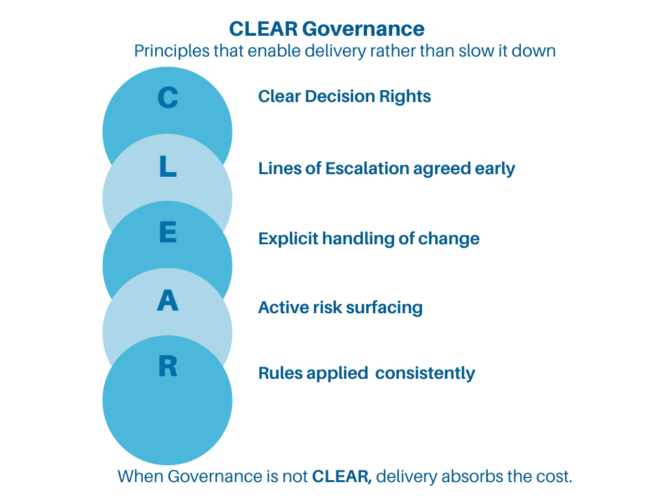
I think of this as C.L.E.A.R. governance.
C — Clear decision rights. People know who owns which decisions and where authority sits, reducing delay and confusion.
L — Lines of escalation agreed early. Escalation paths are defined before delivery starts, not invented when issues arise.
E — Explicit handling of change. Changes are assessed transparently, with clear understanding of impact rather than informal workarounds.
A — Active risk surfacing. Risks are raised early and discussed openly, rather than hidden to protect short-term progress.
R — Rules applied consistently. Governance is applied regardless of role or seniority, which builds trust and predictability.
When these principles are embedded, governance becomes an enabler. Decisions happen earlier. Trade-offs are made consciously. Delivery feels calmer and more predictable.
Importantly, good governance creates confidence. Teams are more willing to surface uncertainty when they trust how it will be handled.
Governance and the Other Operating Model Gaps
Governance rarely fails in isolation. It interacts closely with the other gaps described in this series.
Misaligned commercials create pressure that governance must absorb. Cultural behaviours reflect how governance operates in practice. Delivery dysfunction is often a symptom of delayed or unclear decisions. Blurred roles and accountability make governance ineffective even when structures exist.
This is why governance needs to be designed as part of the operating model, not bolted on as a control mechanism.
Conclusion
Governance isn’t bureaucracy. It’s a design choice.
When governance is clear, decisions happen earlier, risks surface sooner, and delivery becomes more predictable – not slower. When it’s weak or inconsistently applied, organisations pay the price through rework, frustration, and loss of confidence.
If strategy is to be executed successfully, governance must support decision-making rather than compete with it. That means moving away from viewing governance as overhead, and towards recognising it as one of the core enablers of effective execution.


