


Most organisations are not short of tools or processes. In fact, many are rich in both. There are systems for sales, delivery, finance, support, governance and reporting. There are documented processes, ways of working, and dashboards intended to provide oversight.
And yet, despite all of this, leaders often struggle to answer some very basic questions:
- What work is actually in progress?
- Where are the real risks?
- What is blocking delivery?
- Are we on track to deliver the strategy?
When information exists but insight doesn’t, the problem is rarely the absence of tools. It is a lack of visibility created by fragmentation where tools and processes have evolved in isolation, rather than as part of a coherent operating model.
Tools Don’t Fail — Operating Models Do
It’s easy to blame tools when reporting feels unreliable or decision-making becomes difficult. New systems are often introduced to “fix” visibility problems, only for the same issues to reappear months later. In most cases, the tools themselves are doing exactly what they were designed to do. The issue is that they are optimised locally rather than end-to-end. Each function selects tools and defines processes to meet its own needs, with little consideration for how information flows across the organisation. Over time, this creates a patchwork. Different parts of the organisation see different versions of reality, and no one owns the whole picture. Visibility becomes fragmented not because people are careless, but because the operating model was never designed to produce a single, trusted view of work.
Where Fragmentation Shows Up in Practice
The same patterns appear repeatedly across organisations.
Multiple systems, multiple truths
Sales, delivery, finance and support often rely on different systems, each with its own definitions of progress, effort, value or completion. Individually, these systems make sense. Collectively, they create confusion. When reports conflict, confidence in the data erodes.
Inconsistent use of the same tool
Even where a common system exists, teams often use it differently. Fields are optional, workflows vary, and key information is captured inconsistently. As a result, reporting becomes unreliable and comparisons meaningless.
Processes that exist but aren’t embedded
Many organisations have defined processes and ways of working, but they are not reinforced through behaviour, incentives or governance. Over time, people revert to familiar habits, and processes exist only on paper.
Reporting that reassures rather than informs
Status reporting often focuses on reassurance. Risks are softened, uncertainty is hidden, and problems surface late. What looks like good news reporting is often a symptom of poor visibility.
Manual effort bridging system gaps
Spreadsheets, reconciliations and shadow reports quietly fill the gaps between systems. While these provide short-term answers, they increase effort, introduce error, and further reduce trust in the data. Each of these patterns fragments visibility and makes it harder to understand how strategy is progressing in practice.
The Cost of Poor Visibility
When visibility is weak, the impact is felt quickly. Decision-making slows because leaders don’t trust the information in front of them. Governance becomes reactive, responding to issues rather than anticipating them. Commercial risks go unnoticed until they materialise. Delivery teams lose confidence in plans and reporting, and effort shifts towards explaining status rather than improving outcomes. In these conditions, decisions increasingly rely on opinion and experience rather than evidence. Strategy execution becomes harder to steer, not because the direction is wrong, but because the organisation cannot see clearly enough to course-correct early.
Why Common Fixes Don’t Work
When visibility problems emerge, organisations often respond by adding more layers.
- More reports.
- More dashboards.
- More detail.
- More controls.
While these actions are understandable, they rarely address the root cause. Adding reporting on top of fragmented tools and inconsistent processes simply creates more noise. Without shared definitions, consistent behaviours and clear ownership, additional information does not translate into insight.
Visibility cannot be bolted on. It has to be designed.
Introducing the Visibility Design Loop™
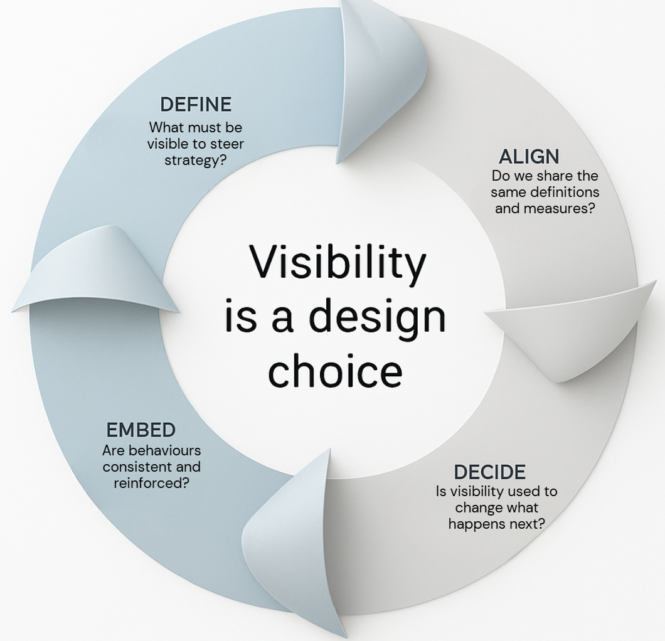
To make this more practical, I often use a simple framework to think about visibility at an operating model level. I call it the Visibility Design Loop™.
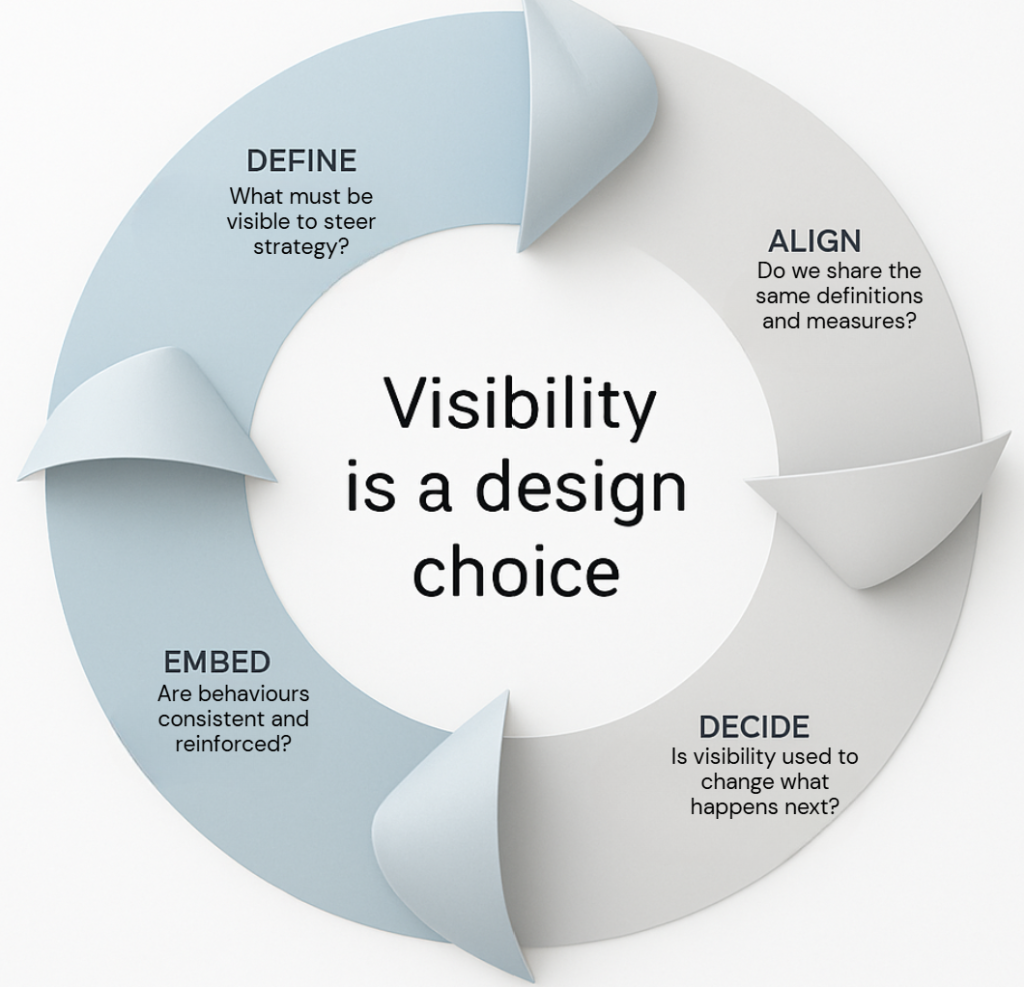
It’s not about selecting tools or designing detailed processes. Instead, it focuses on four design questions that determine whether visibility will ever work in practice.
-
Define what must be visible
Not everything needs to be measured, but some things must be visible if strategy is to be steered effectively. This typically includes what work is in progress, where risk is building, where capacity is being consumed, and where decisions are required.
If leaders can’t agree what genuinely needs to be visible, no tool will fix the problem.
-
Align definitions and measures
Visibility breaks down when the same words mean different things in different parts of the organisation. Terms such as “on track”, “complete”, or “at risk” need shared meaning if information is to be trusted.
Shared visibility depends on shared definitions.
-
Embed consistent behaviours
Processes don’t usually fail because they’re wrong; they fail because they’re optional. Visibility improves when there are clear expectations around how information is captured and maintained, and when those behaviours are reinforced through governance rather than documentation.
Visibility is shaped by behaviour, not process diagrams.
-
Use visibility to drive decisions
This is where many organisations struggle. Data is collected, but decisions don’t change. Priorities remain the same, and risks are acknowledged but not acted on. Visibility only matters if it changes what happens next.
When these four elements work together, tools and processes start to support strategy rather than fragment it.
How Tools and Processes Connect to the Other Operating Model Gaps
Fragmented tools and processes don’t exist in isolation. They amplify the other gaps in the operating model.
Weak visibility undermines governance, because decisions lack evidence. It reinforces the illusion of capacity, because work isn’t fully visible. It shapes culture, because what isn’t measured or surfaced quietly becomes acceptable. And it makes accountability difficult, because ownership cannot exist without transparency.
Without visibility, accountability has nowhere to sit.
Conclusion
Tools and processes matter, but they are not the solution on their own. Visibility is a design responsibility, not a reporting exercise.
When organisations design their operating model to provide a single, trusted view of work, decision-making improves, delivery stabilises, and strategy becomes far easier to steer. Without that clarity, even the best strategies struggle to translate into outcomes.
Visibility doesn’t happen by accident. It has to be designed deliberately and end-to-end.


